What Lenders See
The file lenders read is not the free report
When you apply for credit, the lender pulls your file from Equifax, Experian or illion and reads it before it reads your application. The free report most people have seen is not that file — lenders read the bank-grade version, and it decides the yes or no.
What an assessor reads first
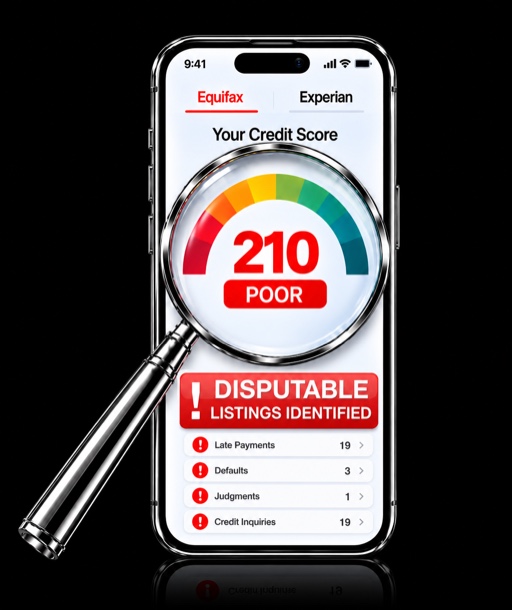
Every default, court judgement and credit enquiry, and two years of month-by-month repayment history on every credit account. A default is read four ways at once: who listed it — a bank or loan provider weighs heavier than a telco or energy company; how much it was for; how old it is; and whether it is paid. An unpaid default tells the assessor there is still an unresolved debt behind you, and many lenders decline on that alone.
The listing is never read on its own. A default surrounded by clean repayment history and few enquiries reads very differently to the same default surrounded by late markers and a cluster of recent applications. Recent behaviour counts, because repayment history refreshes every month.
What lenders actually see

Your real lender file

What It Costs You
Bad credit does not just mean no — it means paying more
Mainstream lenders price their loans for low-risk borrowers, and their automated systems filter out anything that looks like risk. A recent or unpaid listing is often a decline before a person ever reads the file. The lenders who will still consider you price for that risk.
The price of a damaged file
Higher interest rates, sometimes substantially higher. Bigger deposits, or a lower borrowing limit. Extra fees — risk fees and higher establishment costs are common in that part of the market. Over the term of a loan the difference is real money: on our calculator below, a $50,000 business loan over ten years costs about $620 a month with good credit and about $869 a month with bad credit — roughly $29,900 in extra interest for the same money.
It reaches everyday essentials too. Phone plans, internet and utilities run credit checks, and a damaged file can mean a knock-back or a bond on those as well — often for the full five years a listing sits there. Use the calculator below to see the difference on the loan you are actually looking at.
The cost of waiting

Knocked Back?
A decline is not the end of the road — but what you do next matters
Finance knocked back over old listings is usually a credit-file problem before it is anything else. The answer is sitting on the file. The mistake most people make at this point is to keep applying.
The traps after a decline
Application shotgunning. Every application adds an enquiry to your file, and enquiries stay for five years. A burst of declined applications reads to the next lender as financial stress, which makes the next decline more likely, not less. Payday and “no credit check” products. The check is skipped because the cost is loaded elsewhere, and small fast loans can turn one unpaid debt into several, each able to become its own listing. Being told to come back later. Waiting is not a plan — if a listing was not reported the way the law requires, it can be challenged now.
The stronger play is to stop applying, find out exactly what is on both files and whether any of it can be challenged, fix what can be fixed, and apply once — from the best position the file allows. That is what the credit file assessment is for.
Home loan knocked back

Car finance keeps bouncing

Refinance blocked

Knocked back over bad credit

Told to come back later

How Long It Lasts
Most listings stay for five years — paid or not
Defaults, court judgements and credit enquiries are held for five years. Repayment history is held for two. Serious credit infringements are held for seven. Paying a default does not remove it — it updates the status to paid and the listing stays for the full term, and the clock never restarts.
Two ways forward
Wait it out. When a listing reaches the end of its term it must come off, and a lender reading your file after that simply does not know it was there. If a listing is close to its drop-off date, check the exact listing date before you do anything else.
Challenge it. Every listing has to have been reported the way the law requires to be on your file at all, and listings fail that test more often than people expect. A listing that comes off because it should never have been there is a genuine reset — years earlier than waiting. Which path suits you depends on the listing, your timeframe, and what a higher rate would cost you in the meantime.
Paying does not remove it

The five-year rule



 Licensed
